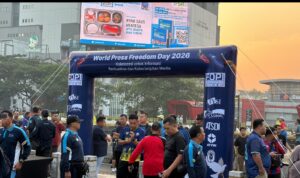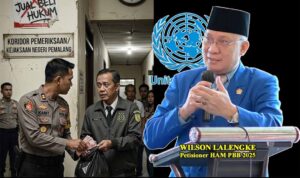
Jakarta ||Bharatanews.com-The observance of International Press Freedom Day, celebrated annually on May 3rd, serves as a poignant reminder of the vital role a free and independent press plays in the health of a global society. That day – specifically today, May 3, 2026 – is a day to evaluate the state of press freedom around the world, defend the media from attacks on their independence, and pay tribute to journalists who have died in the line of duty.

The origin of this significant day dates back to 1991, during a UNESCO seminar in Windhoek, Namibia. African journalists gathered to discuss the development of a free, independent, and pluralistic press. The resulting “Windhoek Declaration” became a landmark document in the struggle for media independence.
In 1993, the UN General Assembly, following a recommendation from UNESCO’s General Conference, officially proclaimed May 3rd as World Press Freedom Day. It was intended to act as a reminder to governments of their duty to respect and uphold the right to freedom of expression as enshrined under Article 19 of the 1948 Universal Declaration of Human Rights.
*Philosophical Foundations: The Marketplace of Ideas*
The principles of press freedom are rooted in centuries of philosophical discourse. Philosophers like John Milton (1608-1674), in his 1644 treatise Areopagitica, argued against government licensing of the press, asserting that truth would always prevail in a “free and open encounter.”
Later, John Stuart Mill (1806-1873), in On Liberty, expanded this by suggesting that even unpopular or “false” opinions should be heard, as they force society to re-examine and strengthen the truth. These thinkers established the “Marketplace of Ideas” concept, the belief that free speech and a free press are the ultimate tools for societal progress and the discovery of truth.
Press freedom is not merely a professional privilege for journalists; it is a fundamental human right. It is intrinsically linked to the right of the public to know. Without a free press, other human rights, such as the right to a fair trial, freedom of assembly, and the right to health and education, become vulnerable. The press acts as a “watchdog,” holding those in power accountable and exposing abuses of authority. In any democracy, the press provides the oxygen of information necessary for citizens to make informed decisions.
*Global Challenges: The Shrinking Space for Truth*
Despite its importance, press freedom is currently facing an existential crisis. The rise of digital authoritarianism, where governments use sophisticated technology to surveil, censor, and harass journalists, has significantly curtailed media independence.
Furthermore, the spread of “fake news” and state-sponsored disinformation campaigns has eroded public trust in traditional journalism. Economic pressures, exacerbated by the shift of advertising revenue to tech giants, have forced many independent news outlets to close, creating “news deserts” where local corruption can go unchecked.
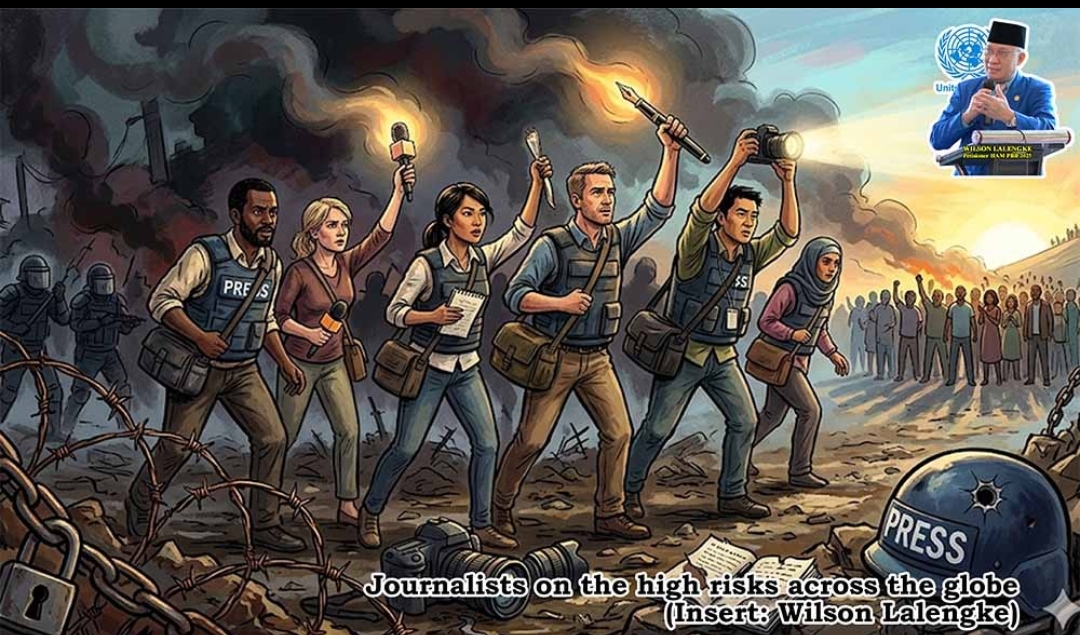
The physical safety of journalists remains one of the gravest concerns. In conflict zones, from Ukraine to Gaza and Sudan, journalists are not just accidental casualties; they are often targeted to prevent the world from seeing the realities of war.
According to the Committee to Protect Journalists (CPJ), recent years have seen record numbers of media workers killed, kidnapped, or disappeared. Beyond physical battlefields, the “legal battlefield” is equally dangerous. Strategic Lawsuits Against Public Participation (SLAPPs) are increasingly used by wealthy individuals and corporations to bankrupt and silence investigative reporters.
*Violations Across the Globe and in Indonesia*
Press freedom violations are rampant across a spectrum of political systems. In autocratic regimes, journalists face long prison sentences for “anti-state activities,” while even in established democracies, we see a rise in hostile rhetoric from political leaders that incites violence against the media.
In Indonesia, despite the democratic progress since the “Reformasi”, press freedom remains fragile. Concerns persist regarding the use of the Electronic Information and Transactions (ITE) Law to criminalize journalists and citizens who criticize officials.
Physical violence against regional reporters and the lack of transparency in conflict-prone areas like Papua continue to be highlighted by organizations such as the Alliance of Independent Journalists (AJI) and the Indonesian Citizen Journalists Association (PPWI). These conditions indicate that legal protections on paper do not always translate to safety in practice.
*A Call for Global Respect*
As we look to the future, the hope remains that all nations will recognize that a free press is not an enemy, but a partner in progress. Respect for press freedom is a hallmark of a confident and stable nation.
It requires more than just the absence of censorship; it requires an environment where journalists can work without fear of retaliation, where whistle-blowers are protected, and where the public values the labour of those who speak truth to power.
International Press Freedom Day is a call to action. It is a call for governments to release imprisoned journalists, for tech companies to protect the digital safety of reporters, and for the global public to support independent journalism. Only through a collective commitment to these principles can we ensure that the “marketplace of ideas” remains open and that the flame of truth continues to burn bright in every corner of the world. (*)
_Author is the Chairperson of the Indonesian Citizen Journalists Association_